Article
Hurrian Crete: Eastern Ancestry, Linear A, and the Making of Minoan Palace Culture
A hundred years of excavation and the ancient DNA of 2017 converge on one population: the Hurrians.
Short on time? Read the 7-minute version written for the general reader.
1. Introduction
The question of Minoan relations with the Near East has been contested since Evans began excavating Knossos in 1900. Evans acknowledged Oriental contact but consistently minimised its significance, presenting Minoan civilisation as a creatively "assimilative" European counterpart to the older cultures of Egypt and Mesopotamia. His framing set the terms of the debate for half a century, and it is the reason the eastern evidence was, for so long, set aside.
But Evans did not deny the connection, and a substantial body of scholarship pushed against his minimisation. John Pendlebury, in The Archaeology of Crete (1939), argued that "of the direct influences Anatolia plays the most important part" in the Early Minoan period, and proposed "an actual wave of immigrants from South-Western Asia Minor" — a direct claim of Anatolian demographic input, made in the same decade as Evans's final volumes. Henri Frankfort published on Syrian and Anatolian influence on the Aegean world in 1924. Gordon Childe treated the Minoans as having an oriental background in tension with their later role as the first European civilisation. Woolley, excavating Alalakh, argued that the frescoes he found "constitute unmistakable evidence for the influence exercised by western Asia on the development of Crete," and proposed that Levantine and Syrian artists had travelled to Crete to execute them. His specific inference has not held — the consensus now assigns the Alalakh, Qatna, Tel Kabri, and Tell el-Dab'a frescoes to Aegean artists working in the east, and the frescoes therefore attest movement in the opposite direction to the one Woolley proposed. But the broader claim he was making, that western Asia was involved in the formation of Minoan Crete, the genetics has since vindicated on independent grounds. Later, Dunbabin and Boardman argued for resident Phoenician craftsmen in Crete rather than mere trade contact, and Kretschmer, revived by Blegen and Haley in 1927, argued for an Anatolian linguistic substrate in pre-Hellenic Aegean toponymy. The autonomist position was defended too — Nilsson and Hall insisted that Mycenaean civilisation was Greek in origin and character and that no Oriental deus ex machina was needed — but it was a position, not a consensus.
What the genetics did, then, was not to introduce a connection that had been unthinkable. It was to give the connection a character that none of the earlier advocates had anticipated. Pendlebury, Frankfort, Childe, and Woolley were all right that the east was involved. All of them assumed the relevant east was the Levant or the Anatolian coast. The Caucasus/Iran character of the component was a surprise to every position in the debate.
The third framing is more recent. The population-genetics literature of the last decade has established that Minoans carry 9–17% ancestry related to populations of the Caucasus and Iran, alongside a predominantly Aegean and western Anatolian Neolithic base. But that literature has treated "Anatolian" and "Caucasus/Iran" as abstract proxies, not as historically attested populations. The 2023 Aegean aDNA study concluded that the eastern gene flow into Crete was "predominantly of Anatolian origin," but its Anatolian proxy was a broad Late Chalcolithic/Early Bronze Age grouping, not a named population, and the study did not test the northern Syrian proxies that the Hurrian corridor supplies.
The result is a curious situation. The population that carried the Iran/Caucasus ancestry into the Near East, that is attested in the corridor for two and a half millennia, and whose language and religion shaped the Hittite state, has been written out of the Minoan question by a combination of Evans's Eurocentrism, Woolley's Levantinism, and the abstraction of genetic proxies.
This paper puts them back. Section 2 establishes the Hurrian archaeological record from Urkesh in the fourth millennium through the Khabur corridor, Arslantepe, central Anatolia, the trade networks, and Ugarit, and then sets out the Minoan material record of contact. Section 3 sets out the genetic discovery and its limits. Section 4 sets out the linguistic evidence, including a typological argument that narrows the candidate field. Section 5 draws the convergence together. Sections 6–7 set out limitations and conclusions.
The argument is not that the Hurrians founded the Minoan population. The Minoan population is predominantly descended from Neolithic farmers of the Aegean and western Anatolia. The argument is that the eastern component — the 9–17% Caucasus/Iran-related ancestry — is best identified as Hurrian-associated, and that this component is the one through which the distinctively palatial institutions of Minoan Crete are hypothesised to have been constituted.
2. The Hurrian Archaeological Record
The Hurrians are one of the longest-documented peoples of the ancient Near East. Speiser's Introduction to Hurrian (1941) and his 1953 essay on Hurrian participation in the civilisation of Mesopotamia, Syria, and Palestine established the linguistic and cultural framework. Wilhelm's The Hurrians (1989) gathered the scattered threads into the first comprehensive English survey. Speiser, Kammenhuber, Goetze, and a century of philological scholarship established the language, the onomasticon, and the religious corpus. The archaeological record, set out below, establishes their presence across the corridor from the fourth millennium BC.
2.1 Urkesh and the fourth-millennium foundation
The Buccellati excavations at Urkesh (Tell Mozan) establish that the city was a Hurrian foundation dating back to at least 4000 BC, with its beginnings "clearly in the fourth millennium, at the same time as the great Sumerian cities in the south and the beginning of the Kura-Araxes migrations." The identification rests on a cluster of material traits rather than on language alone.
A niched monumental building of the mid-fourth millennium was found immediately beneath the third-millennium temple terrace, dated by glyptic, ceramic, and ¹⁴C determinations and identified as "almost certainly the 4th-millennium precursor of the later temple complex." Horseshoe-shaped hearths and andirons in Khabur-period houses were the starting point for linking Urkesh to the Early Trans-Caucasian culture of Georgia and Armenia; Kelly-Buccellati's 2004 paper is explicitly titled "Andirons at Urkesh: New Evidence for the Hurrian Identity of Early Trans-Caucasian Culture." Kura-Araxes ceramics occur in stratified quantities in the Early Dynastic III temple area and on the primary living floors of the royal palace, showing that "contacts with the north were varied." The seal impressions of the Hurrian king Tupkish and his court gave "witness to the nature of the ethnic identity of this ancient city."
Kelly-Buccellati's reconstruction places the Hurrian movement south from the Caucasus in the late fifth to early fourth millennium, with the founding of Urkesh in the late fourth millennium. The Italian Mission's synthesis states that Urkesh is "the earliest known Hurrian city, with its beginnings clearly in the fourth millennium, at the same time as the great Sumerian cities in the south and the beginning of the Kura-Araxes migrations," and that "the Hurrians, too, came from the northern highlands."

2.2 The Khabur–Trans-Tigris corridor
Hurrian is attested in this corridor before the Yamnaya-related ancestry appears at Bakr Awa (c. 2000 BCE):
- Akkadian sources (c. 2330–2190 BCE) record Hurrian personal and place names at Urkesh (Tell Mozan), Nawar (Tell Brak), Gasur (Nuzi), and Simurrum in the Zagros foothills.
- The Tupkish sealing (c. 2300 BCE) and the Tish-atal inscription (21st century BCE) from Urkesh are the earliest direct evidence of a Hurrian-speaking polity in the Khabur basin.
- By the Middle Bronze Age the Khabur River valley was "the heart of the Hurrian lands for a millennium," and Hurrians are attested further west in northern Syria, "such as Alalakh" by 1725 BC.
The Yamnaya-related ancestry at Bakr Awa is part of the genetic composition of a population that was, in part, Hurrian-speaking. The two are not in conflict: a Hurrian-speaking population can carry Yamnaya-related ancestry, just as an Akkadian-speaking population can carry Iran_N-related ancestry. Hurrian is attested in the corridor before the genetic wave, and it remains the attested language of the corridor during the period when the Iran/Caucasus ancestry was establishing itself there.

2.3 The north-westward spread from Urkesh to Arslantepe
Urkesh lies in the Khabur basin. Arslantepe lies approximately 275 km to its north-west, on a bearing of roughly 302°, in the Upper Euphrates region at the junction of Anatolia, Mesopotamia, and the Caucasus. The distance is substantial enough that the movement it represents is not a local shift but a sustained expansion along the Kura-Araxes horizon, and it is consistent with the continuous distribution of Kura-Araxes material across the stretch between the two sites.
The genetic record documents this movement at each stage rather than inferring it from geography. The later Arslantepe individuals are substantially more Kura-Araxes-related than the earlier ones (f4 = 0.0130, Z = 9.55), which establishes that the ancestry moved north-west from the Kura-Araxes sphere into the Anatolian highlands. From there it appears in central Anatolian populations (Büyükkaya, 24–31% Iran-related ancestry) and in southwestern Anatolia (Harmanören) by the Bronze Age. This is the same population whose presence in the Khabur–Trans-Tigris corridor is attested from the fourth millennium, and the same ancestry that the Minoan genomes carry.
The Kura-Araxes horizon is an archaeological entity, not a linguistic label, and its association with Hurro-Urartian languages is a hypothesis rather than a demonstrated identity. What can be said is that it is the material context in which the Hurro-Urartian languages are most plausibly situated, that its expansion is the vector through which both the Iran/Caucasus ancestry and (on this hypothesis) the Hurrian language spread into the corridor, and that this is the best-attested association available. The Urkesh evidence is what supports it: the Buccellati excavations found local Hurrian artifacts bearing affinities with the Kura-Araxes culture.
2.4 Arslantepe as junction
Arslantepe (Malatya) lies in the Upper Euphrates region, at the junction of Anatolia, Mesopotamia, and the Caucasus. Its relevance is as a node and conduit rather than as a Syrian site:
- In its Late Chalcolithic phases it was directly tied to the Syro-Mesopotamian world; in the Early Bronze Age its external relations reoriented toward eastern Anatolia and Transcaucasia, while Syrian and Mesopotamian ceramic types and sealing practices still attest connections "presumably of a trading nature" with Syria.
- Around 3000 BCE the site was transformed by the arrival of Kura-Araxes groups, whose expansion is documented across the Taurus into northern Syria and the southern Levant.
- Arslantepe has produced no Minoan material. Its role in the present argument is as a plausible point of origin and transmission for people and lineages moving through the Anatolian-highland-to-northern-Syrian corridor.
Kelly-Buccellati explicitly attributes the different reception of Kura-Araxes groups at Urkesh and Arslantepe to their "social and cultural affinities with the urbanised Hurrians." Arslantepe was therefore not a linguistically alien node: it was part of the same Kura-Araxes world that carried Iran/Caucasus ancestry into the Hurrian-speaking corridor.

2.5 The Hurrian presence in central Anatolia
The Hurrian presence in central Anatolia is not a Late Bronze Age curiosity. It is documented in the Hittite archives from the formative period of the Hittite state onward. Hurrian occupied a central place in Hittite religious and ceremonial literature — preserved in literary compositions (the Song of Release, the Kumarbi cycle), ritual texts, and bilingual documents, and attested in bulk at Hattusa and Šapinuwa (more than 600 Hurrian texts at the latter alone) — despite being a language distinct from Hittite. The adoption of a foreign language as the medium of a state's most important rituals presupposes an established Hurrian-speaking presence and cultural prestige in central Anatolia. A state does not import a foreign language for its most sacred texts unless that language carries established cultural authority and there are speakers or scribes to transmit it.
This is independent of the genetic evidence and independent of the Minoan question. It establishes that by the early second millennium BC, Hurrian-speaking communities were established in central Anatolia, their language carried the prestige of a religious and literary tradition, and their presence was sufficiently substantial that the Hittite state adopted their texts as its own.
2.6 The Anatolian trade network, Cyprus, and Cypro-Minoan
The Bronze Age Anatolian trade network provides independent archaeological support for the corridor model. "Syrian bottles" manufactured in Upper Mesopotamia spread across southeastern Anatolia and reached Kültepe in eastern Cappadocia; trade goods coming from the south arrived at the slopes of the Taurus and beyond. Tin was carried by donkeys through northern Syria and across the Taurus Mountains to Anatolia. This was not a hypothetical route but an archaeologically documented exchange system connecting the Hurrian-speaking zone to the Anatolian interior. The people who operated this network — merchants, transporters, and artisans — were the same populations that carried the Iran/Caucasus ancestry westward.
The Hurrian-associated cultural sphere extended into the eastern Mediterranean. A dedicated assessment of the evidence concluded that "Hurrian influence surrounded Cyprus during the MC III–LC I period," with "Hurrian" motifs appearing on locally manufactured painted pottery, Syro-Hurrian material parallels deriving from Kizzuwatna and North Syria, and steatite bowls whose figurative elements are described as "closely connected with the Hurrian tradition." This is cultural influence within a shared commercial sphere, not Hurrian settlement on the island, and it establishes that the Hurrian-associated zone reached the maritime networks connecting the Syrian coast to the Aegean.
The clearest evidence that Minoan writing travelled is Cypro-Minoan, the syllabary conventionally named by Evans in 1909 for its resemblance to Linear A and generally regarded as deriving from it. It is attested across Cyprus and — more importantly for the present argument — at Ras Shamra-Ugarit on the Syrian mainland, where it was in use into the twelfth century BC. Ugarit is the port at which the Mari archives place Cretan merchants procuring tin. A Minoan-derived script is therefore attested in the same city, in the same period, as the Minoan commercial presence.
The script remains undeciphered, and claims to have deciphered it are premature given the size of the corpus and the absence of a bilingual. Two attempts have nonetheless identified a Hurrian element. Emilia Masson argued in 1974 that the CM2 sub-system — the one to which the large Enkomi tablets belong — was Hurrian, but her attempt did not progress beyond a few sporadic readings, as she herself conceded. Jean Faucounau subsequently published a fuller decipherment in a series of Études chypro-minoennes (Syria 1977; 1980; English summary 1989), declaring CM2 a Hurrian syllabary and the other branches "Cypro-Semitic." The proposal has not been accepted; Thomas Palaima treats it as an example of uncareful decipherment, and reviews have been sharply critical. Neither reading is relied on here. The argument of this paper depends only on the uncontested fact that a Minoan-derived script was in use at Ugarit — the mainland port through which the Hurrian-speaking zone was reached.
2.7 Hurrian at Ugarit: where the lines meet
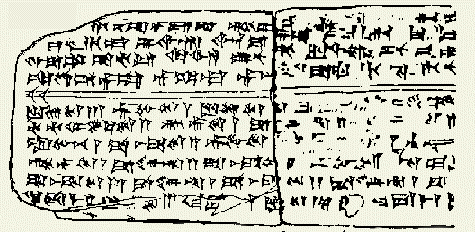
Ugarit is the point at which the separate strands of this argument become a single documented setting. Hurrian was not a marginal language there. Excavations at Ras Shamra have produced around fifty syllabic Hurrian texts and fragments in four genres — letters, wisdom texts, music, and lexical lists — together with sixteen alphabetic Hurrian texts and fifteen fragments, overwhelmingly religious in character: hymns, incantations, sacrificial lists, rituals, and offerings. Hurrian formed part of the scribal curriculum: the multilingual lexical lists add a Hurrian column to Babylonian compositions, yielding four-column Sumerian–Akkadian–Hurrian–Ugaritic vocabularies and a trilingual Sign–Akkadian–Hurrian exemplar from the House of Urtenu. The scribes were at least functionally bilingual, capable of writing Hurrian when a ritual required it. Hurrian deities entered the Ugaritic pantheon; ritual texts come from a structure identified as the House of the Hurrian Priest; and one assessment concludes that the Ugaritian cult was in the hands of Hurrian personnel. The H6 tablet, a hymn to Nikkal with musical notation, is the oldest known written song with notation and may have been brought to Ugarit by the Hurrians. Onomastically, Hurrian names are frequent among senior officials — one study finds them on the majority of governors and administrators, though the samples are small — while the kings themselves never bear Hurrian names. Hurrian was thus embedded in the administrative and cultic apparatus rather than in the dynasty.
This matters because Ugarit is where the three independent lines of evidence converge. The Mari archives place Cretan merchants resident at Ugarit procuring tin. Cypro-Minoan, a script derived from Linear A, is attested at Ugarit on the Syrian mainland. And a living Hurrian language, a Hurrian scribal tradition, Hurrian cult personnel, and Hurrian names across the senior administration are documented in the same city and period. This is not an analogy between three regions. It is one site at which a Cretan commercial presence, a Minoan-derived writing system, and a functioning Hurrian literate class are attested together — which is precisely the setting in which a Cretan administrative class could have encountered the Hurrian language and its toponyms.
2.8 Bakr Awa and the Transtigris corridor
The 2026 Bakr Awa study sequenced 17 individuals from the Transtigris region, spanning the Bronze and Iron Ages. The study documents substantial genetic heterogeneity during the Bronze Age, characterized by influences of Anatolian, Levantine, and Caucasus/Yamnaya-related ancestries, and identifies the Zagros Mountains as the most parsimonious recent origin for the Caucasus/Yamnaya-related ancestry at the site. The authors explicitly link these findings to "a Hurrian ethnolinguistic presence" at the site, describing Bakr Awa as a "melting pot" of ancient Near Eastern ethnolinguistic groups. The Yamnaya-related southern Caucasus ancestry appears in individuals A22037 and A22039 (c. 2112–1800 BCE) and coincides, in the authors' framing, with expanding Hurrian influence after the Gutian overthrow of the Akkadian empire.
Bakr Awa is not a source proxy for the Minoan question. It is too late, too far east, and too Yamnaya-admixed to serve as a direct source, and its Yamnaya component is a later overlay on the Kura-Araxes substrate rather than part of it. Its value is as independent confirmation that the eastern corridor was genetically heterogeneous by the Bronze Age and that the Hurrian presence there is not a linguistic abstraction but a documented demographic fact.
2.9 The Minoan material record of contact: dates and direction
The material record of contact between Crete and the eastern Mediterranean is chronologically prior to the earliest Minoan genomes that carry the eastern component, and that priority matters for the argument.
The maritime capability for east→west contact was not a Bronze Age innovation. Crete had been colonised from central/Mediterranean Anatolia in the seventh millennium BC by an organised migration that required the transport of at least 15 tons of goods in a single sailing season, implying the use of rowing and/or sail. By the Bronze Age the sea corridor between Anatolia and Crete had been in use for five thousand years. The Thera frescoes show Aegean ships rigged with both sail and oars, capable of long-distance voyaging, and by the Middle Bronze Age the Mari archives document Cretan merchants established at Ugarit to procure tin.
The earliest secure evidence of contact is one-directional, and the direction is east → west:
- The Mochlos silver cylinder seal. A silver cylinder seal of Syrian manufacture, dated to the first half of the third millennium BCE (c. 2500 BCE), was found in an Early Minoan II–III context in the cemetery at Mochlos (context 2700–2000 BCE). The Heraklion Museum records that it was used by an inhabitant of Mochlos soon after being made in Syria — it was not a later heirloom but an object in active early use.
- A second northern Syrian seal. A haematite cylinder seal from Mochlos, excavated subsequently, was also imported from northern Syria and dated to the EM II–MM I range.
- Raw materials. A hippopotamus tusk (approximately 45 cm) in EM IIA levels at Knossos (c. 2650–2450 BCE) demonstrates that raw materials, not only finished artefacts, were moving.
- Metallurgical knowledge. Scholars of early Aegean metallurgy have argued that Minoan weaponry adopted crescent-shaped hafting and triangular rivet systems of North Syrian tradition during EM III–MM II.
During the Early Minoan horizon there is no corresponding body of Cretan material recovered in Syria. Minoan Kamares ware in the Levant belongs to MM II–III (c. 1800–1600 BCE); Minoan stone vessels at Ugarit, Alalakh, and Byblos are later still; the Mari archives are eighteenth century BCE. The earliest secure contexts for the exchanged material are Cretan, and the material is Syrian. This asymmetry establishes the initial direction of contact as east → west.
From the Middle Bronze Age the relationship becomes both more intense and bidirectional. Kamares ware is found at Ugarit, Qatna, Byblos, and Hazor; the Mari archives refer to Crete as Kaptara; Minoan-style frescoes, with distinctly Minoan motifs and Aegean technical signatures, appear in elite contexts at Alalakh, Qatna, Tell el-Dab'a (Avaris), and Tel Kabri. The relationship was not one-directional. Cretan merchants were resident at Ugarit by the Middle Bronze Age, and Minoan artisans worked in the palaces of Alalakh, Qatna, Tell el-Dab'a, and Tel Kabri. Minoans travelled to the Near East, and the period in which Linear A was written (c. 1800–1450 BCE) is the period of that contact.
The chronological priority matters. The earliest Syrian goods in Crete (EM II, c. 2700–2000 BCE) predate the earliest Minoan genomes that carry the eastern component (Moni Odigitria 2210–1680 BCE; Lasithi 2000–1700 BCE). The material contact begins before the genetic signal we can detect, which is consistent with a long process in which trade, small-scale movement, and eventual gene flow were sequential phases of the same relationship rather than a single event. The route may have been coastal or direct; both were within the technical capacity of the period, and the distinction does not affect the direction of the contact.

3. The Genetic Record
3.1 The Lazaridis discovery and the CHG point
The genetic evidence for the Minoan eastern component settles a century-old dispute and raises a new one. Evans had minimised Minoan contact with the Near East; Woolley and others had argued for it. Lazaridis et al. (2017) came down on the side of the eastern-influence tradition: Minoans derive at least three-quarters of their ancestry from Neolithic farmers of western Anatolia and the Aegean, but 9–17% derives from populations related to the Caucasus and Iran, with no measurable Levantine or African contribution. The buried archaeological record — the Syrian seals, the hippopotamus ivory, the North Syrian metallurgical techniques — had been pointing at a real connection. But the genetic character of that connection was not Levantine, as Woolley's framing would have implied. It was Caucasus/Iran-related. The archaeology had been right that the east was involved, and the genetics revealed that "the east" meant something further north and further inland than the Levantine corridor Woolley had in mind.
The 2017 supplementary models are more informative than the headline figure. Moni Odigitria can be modelled with two sources — Anatolia_N plus a single additional eastern source (Armenia_EBA or Anatolia_Chl). Lasithi requires three, and its models include CHG (12.6–15.0%) and Armenia_MLBA (17.7–18.5%) in addition to Anatolia_N. Because Anatolia_N is a source in these models, the CHG term is by construction not Anatolian Neolithic ancestry — it is the excess beyond that substrate, estimated within the model rather than by an external conditioning step. It is therefore the cleanest available evidence that a non-Anatolian-Neolithic component is present at all.
Three points follow. First, CHG is the Caucasus end of Lazaridis's "Caucasus/Iran" compound rather than the Iranian end. That distinction matters: Hurrian is attested in Upper Mesopotamia, eastern Anatolia, and the southern Caucasus, so a Caucasus weighting points toward the corridor this paper argues for, while an Iranian weighting would point away from it. Second, CHG is the deep end of the chain that Kelly-Buccellati's reconstruction describes — the Caucasus hunter-gatherer ancestry of the region in which she places Hurrian origins, prior to the formation of the Armenian populations that carried it south. Armenia_EBA supports "Kura-Araxes"; CHG supports "the Caucasus, before Armenia." Third, the model difference between Lasithi and Moni Odigitria is a site-level finding that does not depend on any of the project's own f4 contrasts, and it is therefore not vulnerable to the substrate confound described in Section 3.3.
That difference has a consequence for how the published result should be read. The 2023 study modelled a pooled Crete EMBA target. The Lazaridis models show that the two Cretan populations do not require the same sources: Moni Odigitria can be modelled with one eastern source, Lasithi needs two. The pooled target therefore averages over populations that were not demographically identical, and any claim that "Minoan" eastern ancestry came from a single source or arrived in a single event must be treated as region-specific until the site-level structure is accounted for.
The CHG component is not required for the Hurrian identification, which rests on the Kura-Araxes association of Armenia_EBA together with the archaeological and linguistic evidence. It is independent confirmation that the eastern ancestry reaches back to the Caucasus, which is where the corridor begins.
3.2 The 2023 Anatolian localization and its limits
Skourtanioti et al. (2023), analysing 102 ancient Aegean individuals, concluded that Crete's eastern gene flow was "predominantly of Anatolian origin." For Crete EMBA, the less strongly rejected two-way model included Anatolia LC-EBA at p = 1.5 × 10⁻³, and a three-way model of West Anatolia N + Anatolia LC-EBA + ~5.4% West Iran N was found to be adequate.
Three points must be stated. First, the published Anatolian fit is weak: the model only becomes adequate with an added Neolithic Iranian component. Second, Ebla and Alalakh were not in the Cretan source rotation, so the Anatolian result is the outcome of the source set the authors chose, not a head-to-head contest against the specific Syrian proxies. Third, the study's own Fig. 4 caption concedes that "other proximal sources fit equally well."
The localization to Anatolia is therefore a narrowing of the question, not an answer to it. Anatolia is a region, not a population, and the study did not identify which Anatolian population carried the component.
The Levantine-affinity objection. Lazaridis et al. (2017) found no measurable Levantine influence in the Minoan genomes, and this is sometimes read as evidence against a northern Syrian source. It is not. The proxy against which Lazaridis tested was Neolithic Levant, and the northern Syrian MBA populations that the present argument concerns do not carry Neolithic Levantine ancestry. They carry a southern Levantine component, acquired in the same Late Chalcolithic/Early Bronze Age horizon as their Caucasus/Zagros component, and amounting to 28–38% of their genome (Skourtanioti et al. 2020). A source population of that composition would not register as "Neolithic Levant" in a two-way model, because most of its genome is Anatolian and Zagros-related rather than Levantine Neolithic. The absence of a Neolithic Levant signal is therefore exactly what a northern Syrian source would predict, not evidence against it. This does not establish a northern Syrian source — nothing in the present analysis does — but it removes the one published result that is commonly cited as excluding one.
3.3 The present analysis: a resolution limit
The present analysis attempted to localise the eastern component below the level of the corridor — to a specific Anatolian region, to a Syrian population, or to a particular site. It could not, and the reason is instructive.
The qpAdm models are rejected at the full-model level. No two-way qpAdm model tested here is an accepted ancestry decomposition; the full-model p-values are reported in the supplement.
The f4 contrasts produced only substrate. An initial set of contrasts suggested that Lasithi shared excess drift with Ebla and Alalakh relative to later Arslantepe, and a separate contrast suggested greater affinity to western than to southeastern Anatolia. Both signals disappeared once the comparisons were conditioned on Neolithic Anatolian ancestry (Barcın_N).
The same pattern held for the Bakr Awa individuals. Of ten Barcın-conditioned contrasts — five individual pairs across both Minoan targets — none reached significance. Where the unconditioned contrasts resolved, they favoured the Zagros-clustering profile (A22038) over the steppe-high ones (A22037, A22039), significant in four of six outgroups for Lasithi, which is consistent with the Kura-Araxes-related rather than the later steppe component. That signal did not survive conditioning. The five focal individuals are not first- or second-degree relatives of one another, and A22038 and A22039 come from the same commingled assemblage (BA1348), so the contrast between them is not a site or period effect.
The apparent signals, in every case, were shared Neolithic substrate rather than a post-Neolithic eastern component.
This is not a failure of the thesis. It is a resolution limit of the current samples, and it defines what the genetics can and cannot do: the eastern component exists, it is Anatolian-mediated, it is weighted toward the Caucasus rather than Iran, and it cannot be localised further without genomes from Cilicia, coastal Syria, or the Khabur basin that do not yet exist. What the genetics establishes is a direction and a character; what it cannot establish is a site.
Two analyses could be run with existing data, and neither has been. The first is a sub-regional f4 matrix across the west-to-east transect — northwest Anatolia (Barcın, Ilıpınar, Ulucak, Yassıtepe), central Anatolia (Ovaören, Devret, Büyükkaya), the southeastern margin (Titriş, Tatika), Arslantepe, the Amuq (Tell Kurdu, Alalakh), and Ebla — run separately for Moni Odigitria and Lasithi, to show where along the cline the Minoan affinity peaks. The second is a set of three-way models pairing Turkey_EBA with an eastern component and a third source, judged on full-model p rather than nested p, to test whether a two-component model becomes adequate once a Caucasus or Levantine stream is added explicitly. Both are clinal or compositional rather than source-identifying, so neither would fall to the substrate confound; and both would narrow the corridor further, even if they could not name the site within it.
3.4 The J2a paternal lineage
Y-DNA haplogroup J2a-Z7671 is the shared deep ancestor of the lineages reported at the relevant sites:
- Arslantepe: ART022 (Chalcolithic, c. 3641–3191 BCE) is assigned to J2a-Z7671 > Z7675 > CTS6804; ART011 (Bronze Age, c. 2860–2506 BCE) to J2a-Z7671 > Z7675 > Z30679.
- Alalakh: ALA011 and ALA123 are on J2a-Z7671 > CTS6804 > FTC350; ALA120 on J2a-Z7671 > Z30679 > BY96242.
- Minoan Crete: APO025 and XAN041 are on J2a-Z7671 > Y13667 (and Y13667 > BY98845).
The lineage traces the same broad corridor as the material and autosomal evidence — Anatolian highlands → northern Syria → Crete — with the Cretan lineages representing a separate downstream branch of the same deep ancestral line.
A provenance note is required. The Z7671 assignments do not derive from Lazaridis et al. (2017), whose Minoan Y-chromosome calls were at the J2a1 level. They derive from Skourtanioti et al. (2023) and from subsequent phylogenetic placement of the published sequences. The Y-chromosome evidence is therefore independent of the autosomal analyses, and it is not affected by the substrate-conditioning results of Section 3.3: a paternal lineage is transmitted without recombination and cannot be conditioned away by Neolithic ancestry.
The J2a-Z7671 pattern is consistent with an elite-associated migration. The Reich Lab (2025) shows that Caucasus-Lower Volga (CLV)-related people contributed at least a tenth of the ancestry of Bronze Age Central Anatolians, where Hittite was spoken. A relatively small, mobile population introduced a new language and a new paternal lineage without replacing the local gene pool. The J2a-Z7671 lineage fits this model.
Three cautions apply. First, a Y-chromosomal lineage is a single paternal line and does not by itself demonstrate genome-wide population movement. Second, the Minoan sample APO025 has 0.21× coverage, which makes the terminal subclade assignment tentative; the deep J2a assignment is secure, the finer resolution is not. Third, the assignments should be verified against the primary publications before being treated as settled.
4. The Linguistic Evidence
4.1 Hurrian as the language of the corridor
The source population is attested as Hurrian-speaking. The population carrying Iran/Caucasus-related ancestry in the eastern corridor is attested as Hurrian-speaking from the late third millennium BCE — through the Tupkish sealing (c. 2300 BCE) and the Tish-atal inscription (21st century BCE) in the Khabur–Trans-Tigris zone, the same region sampled by the Syria_EMBA proxy.
The genetic evidence shows that populations carrying this ancestry moved westward. The same eastern ancestry appears in central Anatolian (Büyükkaya, 24–31% Iran-related ancestry) and southwestern Anatolian (Harmanören) populations by the Bronze Age, on the route toward the Aegean. The movement was continuous, not a single jump.
The most parsimonious inference is that the migrants spoke Hurrian. Since the source population's language is documented, and there is no evidence of language shift along the route, Hurrian is the most likely language of the ancestry-carrying populations as they moved through Anatolia toward the Aegean.

4.2 The typological argument
Linear A is open-syllabic, with syllables of CV, VCV, and CVCV shape and few consonant clusters — a structure comparable to Japanese and unlike the complex onsets and codas permitted by Indo-European. Its morphology shows productive affixing, whether prefixal, suffixal, or both. The first is a script fact that scholars extend to the language; the second is consensus.
The languages of the ancient Near East that combine open syllables with productive affixing are few: Sumerian, Elamite, Hurrian, Urartian, and Hattic. The field narrows as follows:
- Hattic is attested almost entirely through Hittite transmission, with no attested presence in western Anatolia or the eastern Mediterranean. It represents the substrate over which the eastern ancestry spread, not the language of its carriers.
- Urartian is attested from the 9th century BCE, confined to eastern Anatolia, and is a close relative of Hurrian — pointing to the same family rather than to an alternative.
- Elamite is confined to Iran and its immediate surroundings, with no Mediterranean presence.
- Sumerian has a deep scribal tradition but no sustained eastern Mediterranean presence and no western Anatolian migration.
The candidate that remains, and the only one independently attested across the corridor through which the eastern ancestry moved, is Hurrian.
It is worth noting that all five candidates are eastern. The typological argument therefore does not merely narrow the field; it locates it, and it locates it in the same direction as the Caucasus/Iran-related component identified in Minoan genomes. Within that eastern set, only Hurrian is attested across the relevant corridor.
This does not identify the language of Linear A; it establishes that among attested candidates, Hurrian is the only one that satisfies the typological, chronological, and geographic constraints simultaneously.
A completely unknown language isolate remains possible in principle. The surviving corpus is small, and a language not attested anywhere in the record could satisfy the same structural constraints. But such a hypothesis would require an undocumented population, an undocumented archaeological record, and an undocumented linguistic identity in order to explain exactly the evidence that Hurrian already explains with documented ones.
4.3 Independence from the genetic source question
The genetic debate concerns the proximate source of the eastern ancestry. The linguistic question is separable, and its answer does not depend on which genetic hypothesis prevails.
If the northern Syrian corridor is confirmed as the proximate source, the migrants came from a Hurrian-speaking region, and Hurrian is the natural inference. If Anatolia is confirmed instead, the relevant Anatolian population is the one that carried the eastern ancestry into central Anatolia, and that is precisely the population among whom Hurrian religious texts were later transmitted and for whom Hurrian held ceremonial prestige. Under either genetic outcome, therefore, Hurrian is by far the best-supported candidate for the language of the ancestry-carrying population.
This is an inference, not a demonstrated fact: language shift is possible, and the western Anatolian linguistic record is absent. But the inference is robust to the outcome of the genetic source debate, and the typological argument narrows the field independently of it.
4.4 Linear A and elite administration
Writing in the Aegean Bronze Age was a palatial and administrative practice: Linear A is confined to palaces, villas, and their sealed contexts, so the language of the script is the language of the administrative class, not of the rural majority. According to van Soesbergen's readings, the Linear A corpus contains Hurrian personal names, toponyms, theonyms, and grammatical forms, including the plural article and genitive suffixes, together with administrative name-lists of the same sentence-name types found in Near Eastern and Anatolian centres.
The toponyms are especially telling: pa-i-to (Phaistos) matches the Hurrian building-verb form ba-'à-ás-to/um attested in the Tish-atal inscription from Urkesh; ka-pa corresponds to Ḫalba (Aleppo); and ku-mi is the Hurrian toponym Kummi, identified with the harbour of Kommos. Naming new settlements after celebrated cities of the old country is a documented practice among migrant populations, and the Greek colonial world supplies the closest Mediterranean parallel.
The setting for that encounter is documented, as Section 2.7 sets out: Cretan merchants resident at Ugarit, Cypro-Minoan attested at Ugarit, and a living Hurrian scribal and cultic tradition at the same city in the same period. The toponyms are what a Cretan administrative class in that setting would be expected to produce.
This is the expected linguistic correlate of the demographic model advanced here: a small, mobile, elite-associated population introducing or managing literacy in the language it spoke — a pattern consistent with the sparse J2a-Z7671 lineage and with the Reich Lab (2025) model of elite transmission of Hittite into central Anatolia. The genetic evidence does not validate the decipherment, which stands or falls on its philology; but it makes the decipherment's implication historically coherent, and the typological argument establishes that the hypothesis is the one worth testing rather than one of several equally plausible candidates.

4.5 Scope
Three qualifications bound this argument. First, the genetic and archaeological evidence support a network rather than a simple chain: the eastern component is a deep Caucasus/Zagros ancestry distributed across Anatolia and northern Syria by the Bronze Age, and no single sampled population is the source. Second, the claim is about the language of a population carrying a specific ancestry, not about the identity of every individual migrant; language shift is a real phenomenon. Third, the western Anatolian linguistic attribution remains unknown in the absence of contemporary texts; Hurrian is the best-supported attested candidate, not a demonstrated fact. The argument concerns the language of the migrants and of the administrative class attested in Linear A; it does not claim that the rural Minoan population as a whole spoke Hurrian.
5. Synthesis: The Convergence
The three lines of evidence are not independent observations that happen to point the same way. They describe the same population in three registers.
The archaeological record establishes the Hurrian presence in the corridor from the fourth millennium BC: the foundation of Urkesh, the material markers that link it to the Transcaucasian sphere, the north-westward spread to Arslantepe across some 275 km of the Upper Euphrates piedmont, the Khabur–Trans-Tigris attestations, the Hurrian texts in the Hittite archives, the trade network that carried Syrian goods through the Taurus into central Anatolia and onward toward the west, and the cultural influence in the eastern Mediterranean attested on Cyprus. At Ugarit, the three lines meet in a single documented setting: Cretan merchants, Cypro-Minoan, and a living Hurrian scribal and cultic tradition. The record also establishes that Syrian goods reached Crete from EM II, earlier than the earliest Minoan genomes carrying the eastern component.
The genetic record establishes that the eastern component is 9–17% of Minoan ancestry, Anatolian-mediated, weighted toward the Caucasus rather than Iran, and — in Lasithi specifically — CHG-related. That is the Kura-Araxes stream. The component cannot be localised below the level of the broader corridor with current samples, but its eastern character and its Kura-Araxes affinity are established, and the two Cretan populations do not require the same sources.
The linguistic record establishes that Linear A is open-syllabic with productive affixing, that the attested languages combining those features are all eastern, and that among them only Hurrian is attested across the relevant corridor.
The convergence is chronological as well as geographical. The Hurrian expansion from the Caucasus and the founding of Urkesh fall inside the Almarri window for the Caucasus/Zagros admixture pulse (5,900–3,300 years ago). The northern Syrian MBA population, already admixed, predates the Minoan samples. The Hittite adoption of Hurrian as the language of its most sacred texts presupposes an established Hurrian-speaking presence in central Anatolia. The material contact with Crete begins in EM II and intensifies in the Middle Bronze Age.
The ancestry documented at Urkesh in the fourth millennium, in Anatolian populations by the Bronze Age, and in the Northern Levant through the massive replacement documented by Skourtanioti et al. (2020) is not three separate phenomena. It is a single ancestral stream, documented at three points along the same corridor, and the Minoan eastern component is a downstream expression of it. Which of the three points was proximate cannot be determined from the current samples; that it is the same stream can.
5.1 The palace hypothesis and the limits of its testing
The claim advanced here is that the eastern component is not a marginal additive to an otherwise self-generated Minoan culture, but the component through which the distinctively palatial institutions of Minoan Crete were constituted: the administrative script, the accounting palace, and — on van Soesbergen's readings — the cult and the toponymy.
This is a hypothesis, not a demonstrated conclusion. Ancestry proportions do not assign institutional origins, and the appearance of Linear A, the development of the accounting palace, and the local elaboration of seal use each require their own archaeological argument.
The hypothesis cannot be tested through the stratigraphy of Knossos and Phaistos. The Early Minoan levels at both sites were largely destroyed by the construction of the first palaces in the Middle Minoan period. At Knossos, the EM III–MM II court buildings were almost entirely removed by later levelling and rebuilding; at Phaistos the situation is comparable. The precursor sequence that a direct stratigraphic test would require no longer exists at the two sites where the earliest palaces were built.
What can be tested is comparative and transitional. The earliest administrative use of sealings on Crete is at MM IIB Phaistos, not in the Early Minoan period. Before that, seals were in use from EM II but in a limited, status-oriented capacity rather than as instruments of administration. Two lines of evidence bear on the transition. First, the MM IIB Phaistos sealing system has close links with the multiple-sealing administrative system attested at Karahöyük Level I in Anatolia, which is a comparative argument for transmission rather than independent invention. Second, the appearance of the administrative system at Phaistos is abrupt rather than gradual, which is consistent with the introduction of a package rather than its local elaboration.
If that comparative and transitional evidence is confirmed by further work at sites with surviving Early Minoan sequences, the hypothesis of an introduced administrative package gains support. If it is shown that the MM IIB system developed continuously from local Early Minoan sealing practices, the hypothesis fails.
What can be said with confidence is narrower and still substantial. The Neolithic population, the ceramic tradition, and the artistic idiom of Minoan Crete are Aegean. The literate palace and its religious apparatus are where the Hurrian-associated element is located. The genetic evidence is consistent with this but does not by itself localise the source; what sustains the argument is the convergence of archaeology, chronology, genetics, and linguistics.
6. Limitations
The qpAdm models are rejected at the full-model level, and an earlier draft of this analysis applied the f4 sign convention in reverse. The corrected results are reported in Section 3.3; the raw outputs are in the supplement. The fitted coefficients are diagnostic output from rejected models, not ancestry proportions, and are sensitive to the outgroup set and to the composition of the Anatolian grouping.
Turkey_EBA originally contained Arslantepe individuals. The original pooled model's Anatolian source included individuals from the site this paper treats as a Hurrian conduit. The removal diagnostic shows the fit does not depend on them, but the composition must be stated, because it means the original Anatolian-versus-Syrian contrast was partly internal to one pool. The Barcin_N conditioning proxy rests on two individuals and is therefore a thin proxy rather than a representative Neolithic Anatolian sample.
A recent methodological critique bears on the Anatolian samples. Bukalov (2025, preprint) argues that most samples labelled "Hittite" in Anatolian aDNA studies derive from pre-Hittite Hattian or Hurrian pit-burial contexts rather than from Hittite funerary practice, and that several sites in the Turkey_EBA grouping fall into this category. This does not affect their use here as a geographic Anatolian proxy, but it reinforces the point that the Anatolian and northern Syrian proxies are not cleanly distinct cultural categories.
The Cyprus evidence is influence, not settlement, and Cypro-Minoan is undeciphered. The "Hurrian influence" on Cyprus during MC III–LC I is cultural and commercial, not demographic, and does not establish a route. The Hurrian readings of Masson (1974) and Faucounau (1977–1989) are not accepted, and nothing in this paper depends on them. The argument relies only on the uncontested attestation of a Minoan-derived script at Ugarit and on Cyprus.
The palace hypothesis cannot be tested stratigraphically at Knossos and Phaistos. The Early Minoan levels at both sites were largely destroyed by palace construction, so the direct precursor sequence no longer exists. The hypothesis is stated with a comparative and transitional test rather than a stratigraphic one.
Sample-size limits on the Y-DNA and the Arslantepe chronology. The Minoan J2a-Z7671 assignments require verification against the primary publications; APO025 has 0.21× coverage and its terminal subclade is tentative. The later Arslantepe sample is n = 4, so the Z = 9.55 result should be replicated with larger samples before it anchors any chronological claim.
The Bakr Awa analysis is complete and null, and no genome-wide aDNA has been published from Tell Mozan/Urkesh, Tell Brak, Cilicia, or coastal Syria for the Chalcolithic or Early Bronze Age periods. The Bakr Awa individuals establish the heterogeneity of the corridor and are consistent with a Kura-Araxes-related rather than steppe-related component in the Minoan signal, but all conditioned contrasts are null. The remaining route question requires the Cilician and Khabur genomes that do not yet exist.
7. Conclusion
The Hurrians have been known to scholarship for more than a century, but they have been largely absent from the Minoan-origins debate. This paper puts them back into it. The archaeological record establishes their presence in the eastern Anatolia–Upper Mesopotamia–northern Syria corridor from the fourth millennium BC, their material links to the Transcaucasian world, their north-westward spread to Arslantepe and into the Anatolian highlands, their cultural prestige in central Anatolia before the Hittite state, their participation in the trade networks that carried Syrian goods into the Anatolian interior, and their cultural reach into the eastern Mediterranean. At Ugarit, the record places Cretan merchants, a Minoan-derived script, and a living Hurrian scribal and cultic tradition in the same city and period. It also establishes that Syrian goods reached Crete from EM II, earlier than the earliest Minoan genomes carrying the eastern component.
The genetic record establishes that the eastern component is 9–17% of Minoan ancestry, with no measurable Levantine contribution, Anatolian-mediated, weighted toward the Caucasus rather than Iran, and — in Lasithi specifically — CHG-related. That is the Kura-Araxes stream. The component cannot be localised below the level of the broader corridor with current samples, but its eastern character and its Kura-Araxes affinity are established, the two Cretan populations do not require the same sources, and the J2a-Z7671 paternal lineage traces the same corridor independently of the autosomal analyses.
The linguistic record establishes that Linear A is open-syllabic with productive affixing, that the attested languages of the region combining those features are all eastern, and that among them only Hurrian is attested across the relevant corridor. That does not identify the language of Linear A; it establishes that the Hurrian hypothesis is the one worth testing rather than one of several equally plausible candidates.
The three lines converge, and none of them alone carries the argument. The Minoan population is predominantly Neolithic Aegean; what the eastern component contributed is hypothesised to be the literate palace and its administrative apparatus. That hypothesis cannot be tested through the stratigraphy of Knossos and Phaistos, where the Early Minoan levels were destroyed by palace construction. It is tested comparatively and transitionally — through the MM IIB Phaistos sealing system's links to Karahöyük Level I, and through the abruptness of the transition from status-symbol to administrative sealing — and it remains a hypothesis rather than a demonstrated conclusion.
That is the strongest claim the evidence supports, and it is a substantial one. The Hurrians are back in the Minoan question, and the evidence assembled here is enough to keep them there.